Your HVAC system works harder in Florida than almost anywhere else in the country. While homeowners in northern states give their AC a break for six months, your system runs 10 to 12 months out of the year. That kind of constant demand wears down components faster and makes routine maintenance the difference between a system that lasts 15 years and one that fails at 8.
This HVAC maintenance checklist covers everything Florida homeowners need to do each season, each month, and each year to keep their systems running efficiently. Whether you handle the basics yourself or schedule a professional HVAC maintenance visit with Trust First Services, this guide helps you stay ahead of costly breakdowns.
Schedule your AC tune-up
February and March are the best months to book before the rush.
Why HVAC Maintenance Matters in Florida
Skipping maintenance in a mild climate might go unnoticed for a year or two. In Florida, the consequences show up fast. The combination of year-round use, extreme humidity, and salt air (in coastal areas) creates conditions that accelerate wear on every component in your system.
Year-Round Demand Means Year-Round Wear
Central Florida averages around 73 degrees annually, with summer highs regularly reaching the mid-90s. Most Orlando homeowners run their AC from March through November, and many run it all year. That is roughly twice as many cooling cycles as a system in Ohio or Pennsylvania completes in a year.
More cycles mean more stress on the compressor, capacitor, contactor, and blower motor. Routine maintenance catches the early signs of fatigue in these parts before they fail on the hottest day of July.
Humidity Compounds the Problem
Orlando's average relative humidity hovers around 74%. Your AC system does not just cool the air. It also removes moisture. When evaporator coils get dirty or refrigerant runs low, the system loses dehumidification capacity. That leads to moisture buildup in your ductwork and around the air handler, creating ideal conditions for mold growth.
A maintenance visit that includes coil cleaning, refrigerant checks, and condensate drain line flushing directly protects your indoor air quality.
The Financial Impact
According to the U.S. Department of Energy, a well-maintained HVAC system runs up to 15% more efficiently than a neglected one. For Orlando homeowners running their AC nearly year-round, that efficiency gain translates to hundreds of dollars in annual energy savings.
On the repair side, the average AC repair in Orlando costs $150 to $450. A maintenance plan that catches problems early costs $150 to $300 per year. The math is straightforward.
Spring AC Tune-Up Checklist
Spring is the most important season for AC maintenance in Florida. You want your system inspected and optimized before April and May, when temperatures climb and your AC starts working at full capacity. Schedule your tune-up in February or March to beat the rush.
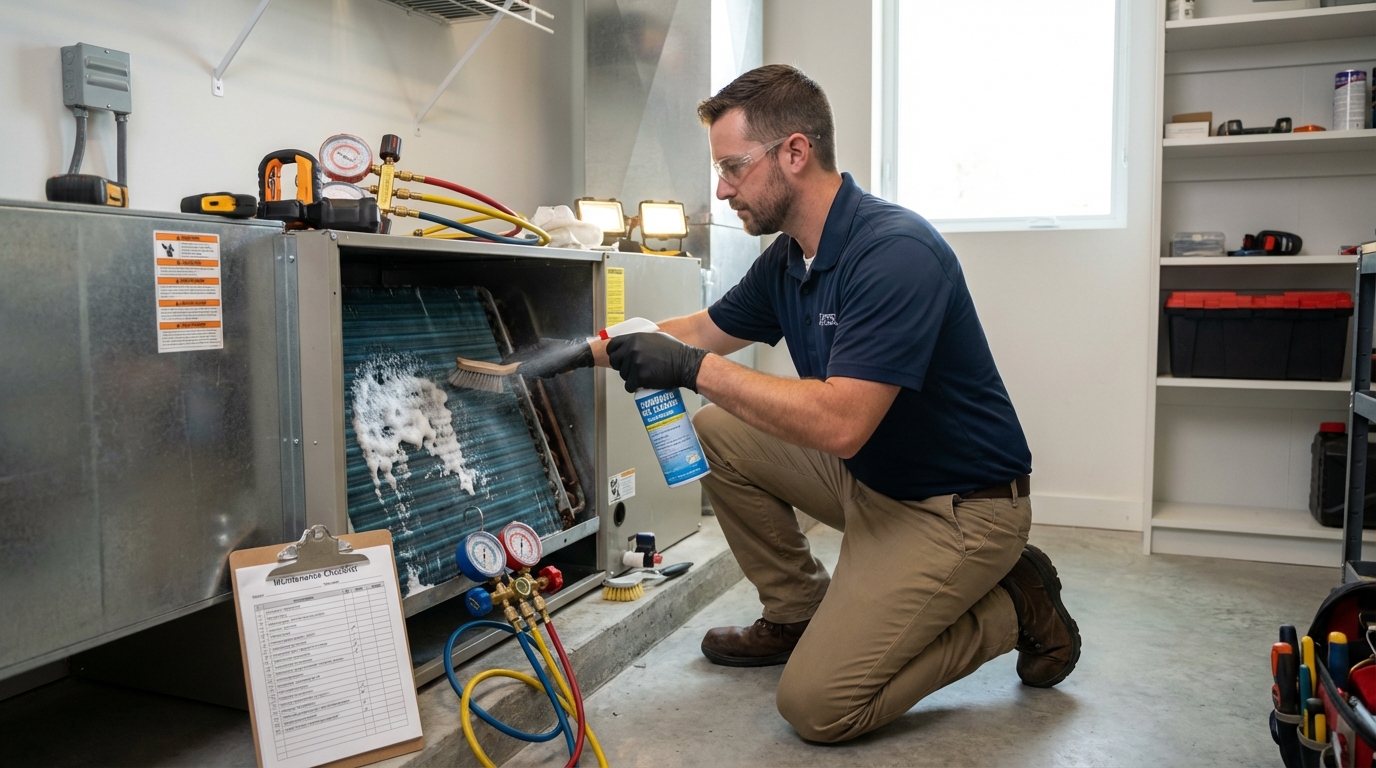
Professional Spring Tune-Up Tasks
A qualified HVAC technician should complete the following during a spring AC tune-up:
Refrigerant System
- Check refrigerant levels and pressure
- Inspect refrigerant lines for leaks or insulation damage
- Verify charge matches manufacturer specifications
Coil Cleaning
- Clean evaporator coils (indoor unit)
- Clean condenser coils (outdoor unit)
- Remove leaves, dirt, and debris from around the outdoor condenser
Electrical Components
- Inspect and tighten all electrical connections
- Test capacitor and contactor function
- Measure voltage and amperage on motors
- Check wiring for corrosion, wear, or overheating
Airflow and Filtration
- Replace or clean air filters
- Inspect ductwork for visible leaks or disconnections
- Check return and supply vents for blockages or obstructions
Condensate Drain System
- Flush and clear the condensate drain line (critical in Florida's humid climate)
- Inspect the drain pan for cracks or standing water
- Verify proper drainage to prevent water damage
Thermostat and Controls
- Calibrate thermostat for accurate temperature readings
- Test system start-up, shutdown, and cycling
- Verify safety controls and emergency shutoff function
Moving Parts
- Lubricate motors and bearings
- Inspect the blower wheel for dirt buildup or damage
- Check the fan blade on the outdoor condenser unit
This is the checklist Trust First Services technicians follow during every HVAC maintenance visit. Each item is documented so you have a record of your system's condition.
Fall Heating Checkup
Florida homeowners tend to skip heating maintenance entirely. That is a mistake. Orlando experiences cold snaps between December and February, with overnight lows occasionally dipping into the 30s and 40s. When those cold nights hit, you need your heat pump or furnace to respond immediately.
Fall Heating Checklist
Heat Pump Systems (Most Common in Central Florida)
- Switch thermostat to heating mode and verify operation
- Inspect the reversing valve
- Check defrost cycle function
- Clean outdoor coils (again, if needed since spring)
- Inspect backup electric heat strips
Furnace Systems (Less Common but Present)
- Inspect the heat exchanger for cracks or corrosion
- Test ignition system and safety shutoff
- Check gas connections for leaks (natural gas systems)
- Inspect the flue and venting
All Heating Systems
- Replace air filter (new season, fresh filter)
- Test carbon monoxide detector batteries
- Inspect thermostat settings and programming
- Clear space around the indoor unit (no boxes, no storage)
Even a brief fall checkup can prevent a heating failure during the two or three weeks Orlando gets genuinely cold weather. The last thing you want is to discover your heat pump is not working at 2 a.m. on a 35-degree January night.
Monthly Homeowner Tasks
You do not need a technician for everything. There are several maintenance tasks every Florida homeowner should handle monthly to keep their system running between professional visits.
Monthly HVAC Maintenance Checklist
- 1
Check and replace your air filter
This is the single most impactful thing you can do. A dirty filter restricts airflow, forces your system to work harder, and increases energy consumption by 5% to 15%. In Florida, where your system runs constantly and deals with high humidity, filters clog faster than in drier climates.
- 2
Inspect the area around your outdoor condenser
Clear any leaves, grass clippings, landscaping, or debris within two feet of the unit. Blocked airflow makes the condenser work harder and shortens its lifespan.
- 3
Check your vents and registers
Make sure furniture, curtains, or rugs are not blocking supply or return vents. Blocked vents create pressure imbalances that stress your system and lead to uneven cooling.
- 4
Look at the condensate drain line
The PVC drain line running from your air handler should be dripping steadily when the AC is running. If it stops dripping or you notice water pooling around the air handler, the line may be clogged. Pour a cup of white vinegar down the drain line every 30 days to prevent algae and mold buildup.
- 5
Listen for unusual sounds
Clicking, grinding, squealing, or buzzing sounds during operation usually indicate a component that needs attention. Catching these early prevents a minor issue from turning into a major repair.
- 6
Check your thermostat
Make sure it is reading the correct temperature and that your programmed schedule still matches your routine. If your thermostat uses batteries, replace them once a year.
How Often Should HVAC Be Serviced in Florida?
The standard recommendation across the industry is to have your HVAC system professionally serviced twice per year: once in the spring for cooling and once in the fall for heating. That applies everywhere. But in Florida, the spring cooling tune-up is significantly more important because your AC does the overwhelming majority of the work.
Recommended Service Schedule
| Task | Frequency | Best Time |
|---|---|---|
| Professional AC tune-up | Annually | February - March |
| Professional heating checkup | Annually | October - November |
| Air filter replacement | Every 30 to 60 days | Year-round |
| Condensate drain line flush | Monthly | Year-round |
| Outdoor condenser cleaning | Monthly | Year-round |
| Duct cleaning | Every 3 to 5 years | Any season |
New Systems vs. Older Systems
If your HVAC system is less than 5 years old, twice-a-year professional service is typically sufficient. If your system is 10 years or older, consider a more frequent schedule. Older systems have more worn components and benefit from closer monitoring.
Systems over 15 years old should be evaluated for replacement during a maintenance visit. Your technician can assess the system's overall condition and help you decide whether continued repairs make financial sense. Trust First Services provides honest assessments. We will tell you if a repair is all you need.
Signs Your AC Needs Maintenance Now
Do not wait for your next scheduled tune-up if you notice any of these warning signs. Each one indicates a problem that gets worse (and more expensive) the longer you ignore it.
- Weak or reduced airflow from vents. Could be a clogged filter, failing blower motor, or ductwork leak.
- Warm air coming from supply vents. Could be low refrigerant, a frozen evaporator coil, or a compressor issue. See our full AC not cooling troubleshooting guide.
- Unusual or new sounds. Grinding, squealing, rattling, or banging sounds during operation.
- Higher than normal energy bills. A sudden spike in your electric bill without a change in usage often points to reduced system efficiency.
- Frequent cycling (turning on and off repeatedly). Called short-cycling, this indicates an electrical problem, refrigerant leak, or oversized system.
- Water around the indoor unit. Usually a clogged condensate drain line, cracked drain pan, or frozen coil that is thawing.
- Bad smells from vents. Musty odors indicate mold in the ductwork or on the coils. Burning smells may indicate an electrical issue.
- Humidity feels high indoors. If your home feels sticky even with the AC running, the system is not dehumidifying properly.
If you notice any of these issues, contact Trust First Services for a diagnostic visit before a small problem turns into a costly AC repair.
Frequently Asked Questions
What is included in an HVAC maintenance checklist?
A complete HVAC maintenance checklist includes filter replacement, coil cleaning (both evaporator and condenser), refrigerant level check, electrical connection inspection, condensate drain line flush, thermostat calibration, and inspection of all moving parts. In Florida, the condensate drain line flush is especially important due to high humidity and mold risk.
How often should HVAC be serviced in Florida?
Professional service should be done twice per year: a cooling tune-up in February or March and a heating checkup in October or November. Air filters should be replaced every 30 to 60 days year-round. Florida's near-constant AC use makes preventive maintenance more critical here than in most other states.
What is the best time to service AC in Florida?
The best time to schedule your AC tune-up in Florida is February or March, before the summer cooling season begins. HVAC companies get busiest from April through September, so early scheduling helps you avoid wait times and ensures your system is ready before temperatures climb.
How often should I change my AC filter in Florida?
In Florida, change your AC filter every 30 to 60 days. Standard 1-inch filters should be replaced monthly. Higher-quality 4-inch or 5-inch media filters can last 60 to 90 days. If you have pets, allergies, or live near construction, check your filter more frequently.
What happens if you skip HVAC maintenance?
Skipping maintenance leads to reduced efficiency (higher electric bills), shortened system lifespan, more frequent breakdowns, and potential indoor air quality problems. In Florida's climate, a neglected system also risks mold growth in the ductwork and drain system. The cost of annual maintenance is a fraction of what you will spend on emergency repairs or premature system replacement.
Is an HVAC maintenance plan worth it?
Yes, especially in Florida. A maintenance plan typically costs $150 to $300 per year and includes one or two professional tune-ups, priority scheduling, and discounts on repairs and parts. For a system that runs 10 to 12 months per year, the energy savings and extended equipment life pay for the plan several times over. Trust First Services offers tiered maintenance plans designed for Florida's demanding climate.
Schedule a Tune-Up
Use this HVAC maintenance checklist to stay on top of the tasks you can handle yourself. For the professional tune-up items, Trust First Services is here to help.
As a veteran-owned and minority-owned company with 25+ years of home services experience, we bring the same discipline, precision, and honesty to every maintenance visit. Our technicians follow a documented checklist for every HVAC service call, and we show you exactly what we find.
Here is what to do next:
- 1Bookmark this page for quick reference throughout the year.
- 2Check your air filter today. If it is dirty, replace it.
- 3Schedule your spring AC tune-up. February and March are the best months to book before the rush.
Related Articles
Trust First Services proudly serves Orlando and 35+ Central Florida cities across Orange, Seminole, Osceola, and Lake counties.