
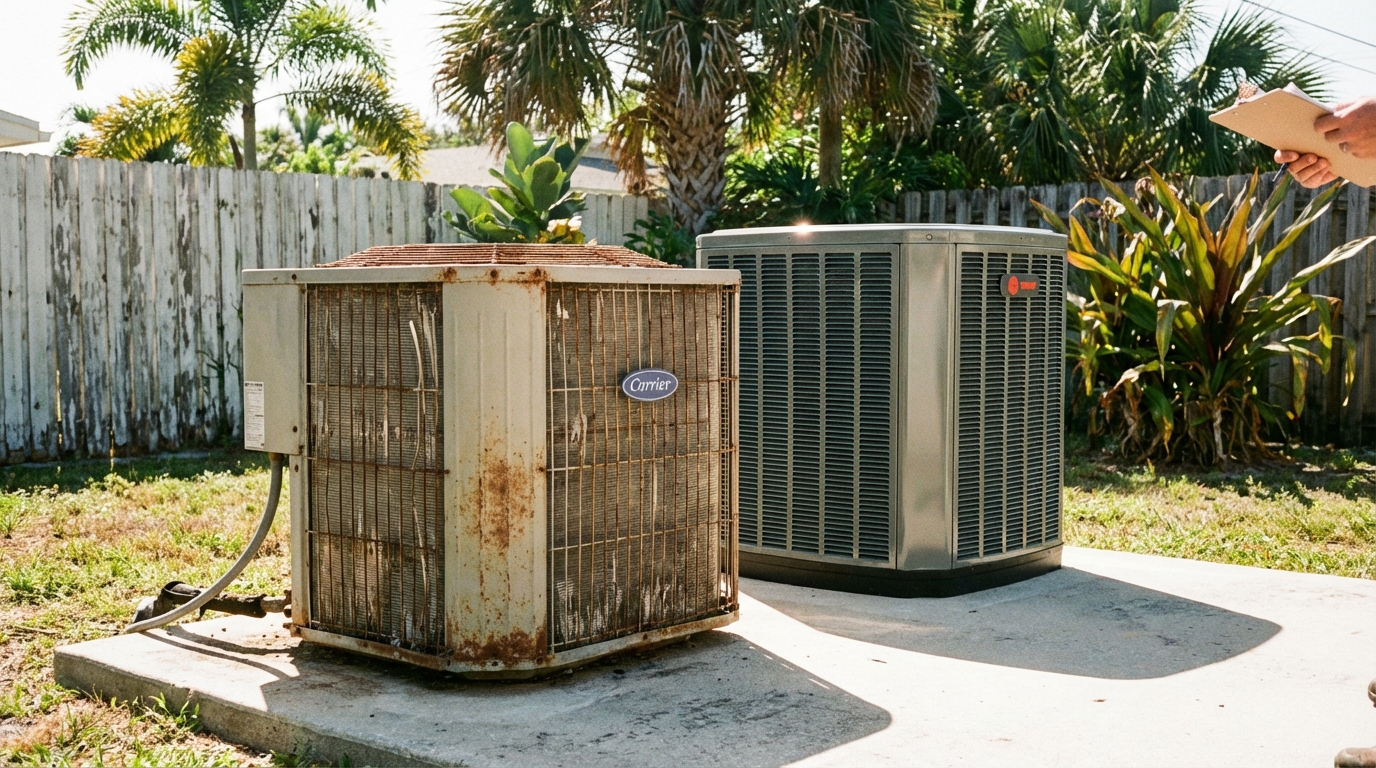
Your AC technician just quoted you $800 for a compressor repair, and your system is 12 years old. Should you pay for the fix or put that money toward a new unit? This is one of the most common questions Orlando homeowners face, and the $5,000 rule gives you a clear, math-based way to answer it.
Trust First Services has helped Central Florida homeowners make this decision for over 25 years. In this guide, we walk you through the $5,000 rule step by step, show you when repair makes sense, and explain when replacement is the smarter investment.
Need help deciding?
Call Trust First Services for an honest assessment.
What Is the $5,000 Rule?
The $5,000 rule is a simple formula that helps you decide whether to repair or replace your air conditioning system. Here is how it works:
Multiply the cost of the repair by the age of your AC unit. If the result is more than $5,000, replace the system. If it is less than $5,000, the repair is likely worth it.
This rule accounts for the two most important factors in the decision: how expensive the repair is and how much life your system has left. A cheap repair on a newer unit is almost always a good call. An expensive repair on an aging system is usually a signal that replacement will save you more money over time.
The $5,000 rule is not the only factor to consider, but it gives you a reliable starting point before you spend hundreds or thousands of dollars on a system that may fail again soon.
How to Apply the $5,000 Rule (Step by Step)
Using the rule is straightforward. Follow these three steps with your actual repair quote and system age.
Step 1: Get Your Repair Estimate
Ask your HVAC technician for a written repair estimate. At Trust First Services, we provide upfront pricing before any work begins so you know exactly what you are dealing with. Make sure the estimate includes parts and labor.
Step 2: Determine Your System's Age
Check the manufacturer's label on your outdoor condenser unit. The serial number usually contains the manufacture date. If you cannot find it, your HVAC technician can look it up during the service call. Most AC units installed in Orlando homes are between 8 and 20 years old.
Step 3: Do the Math
Multiply the repair cost by the age of your unit. Compare the result to $5,000.
| Repair Cost | System Age | Calculation | Result | Recommendation |
|---|---|---|---|---|
| $300 | 8 years | $300 x 8 | $2,400 | Repair |
| $500 | 10 years | $500 x 10 | $5,000 | Borderline |
| $400 | 14 years | $400 x 14 | $5,600 | Replace |
| $800 | 12 years | $800 x 12 | $9,600 | Replace |
| $200 | 6 years | $200 x 6 | $1,200 | Repair |
As you can see, even a relatively modest $400 repair on a 14-year-old system crosses the $5,000 threshold. That is because the older the system, the less useful life remains to justify the repair cost.
When to Repair Your AC
The $5,000 rule is a guideline, not an absolute rule. There are situations where repairing your system is clearly the right move, even beyond what the math says.
Your System Is Less Than 8 Years Old
A well-maintained AC system in Orlando should have years of reliable service ahead if it is under 8 years old. Most repairs on younger systems are worth the investment because you are protecting a significant amount of remaining lifespan.
The Repair Is Minor
Some AC repairs are routine maintenance items that do not signal a larger problem. These include:
- Capacitor replacement ($150 to $300)
- Contactor replacement ($100 to $250)
- Thermostat repair or replacement ($100 to $400)
- Drain line cleaning ($75 to $200)
- Refrigerant recharge (if the leak is small and repairable)
These fixes keep your system running without the expense of a full replacement.
You Have Had Few Previous Repairs
If your system has been reliable and this is the first significant repair, it may be worth fixing. A single repair does not mean your system is on its last legs. However, if you have called for AC repair two or more times in the past 12 months, the pattern is telling you something.
Your Budget Does Not Allow Replacement Right Now
A new AC system in Orlando costs between $5,000 and $15,000. If replacement is not financially feasible right now, a well-executed repair can buy you time. Just make sure to start planning for replacement and consider signing up for an HVAC maintenance plan to extend the current system's life as long as possible.
When to Replace Your AC
When the $5,000 rule points toward replacement, there are usually other factors stacking up as well. Here are the clearest signs that a new AC installation is the better investment.
Your System Is 15 Years Old or Older
The average central AC system lasts 15 to 20 years in moderate climates. In Orlando, that number is closer to 10 to 15 years because your system runs nearly year-round. A system that has passed the 15-year mark in Central Florida is operating on borrowed time, and parts become harder to source as models are discontinued.
Your Energy Bills Keep Climbing
An aging AC system loses efficiency gradually. If your FPL bill has been increasing even though your usage has not changed, your system is working harder to deliver the same cooling output. A new high-efficiency system with a 16 SEER or higher rating can cut your cooling costs by 20% to 40% compared to an older 10 SEER unit.
You Are Facing a Major Component Failure
Some repairs are expensive enough that they tip the scale on their own. These include:
- Compressor replacement ($1,500 to $3,000+)
- Evaporator coil replacement ($800 to $2,000)
- Condenser coil replacement ($700 to $1,500)
- Refrigerant leak on an R-22 system (R-22 has been phased out and costs $100+ per pound)
When one of these components fails on an older system, the $5,000 rule almost always points toward replacement.
Your System Uses R-22 Refrigerant
If your AC unit was manufactured before 2010, it likely uses R-22 (Freon), which was phased out of production in the United States in 2020. The remaining supply is limited and expensive. Recharging an R-22 system can cost $100 to $175 per pound, and most systems need 5 to 15 pounds for a full charge. A new system uses R-410A or newer refrigerants that are readily available and more affordable to service.
You Are Experiencing Frequent Breakdowns
Multiple repair calls within a short period are a sign of cascading failure. When one component fails, it puts additional stress on other parts. Paying for three or four repairs in a year can add up to more than half the cost of a new system, with none of the warranty protection or efficiency gains.
AC Lifespan in Florida
Florida is one of the toughest climates for air conditioning systems in the country. The combination of extreme heat, high humidity, and year-round demand shortens the effective lifespan of every AC unit installed here.
How Long Does an AC Unit Last in Florida?
The typical AC lifespan in Florida is 8 to 15 years, compared to 15 to 20 years in northern states. Here is why:
- Year-round operation: Orlando's average temperature stays above 70 degrees for most of the year. Your AC runs 10 to 12 months annually, accumulating roughly twice as many cooling cycles as a system in a northern climate.
- Humidity stress: Central Florida's average relative humidity hovers around 74%. Your AC system works overtime to remove moisture from the air, which puts extra strain on the compressor and evaporator coil.
- Salt air (coastal areas): If you live in parts of Central Florida closer to the coast, salt air accelerates corrosion on the outdoor condenser unit.
- Power surges: Florida is the lightning capital of the United States. Power surges from storms damage capacitors, control boards, and compressors.
How to Maximize Your AC's Lifespan
Regular HVAC maintenance is the single most effective way to extend your system's life in Florida. An annual tune-up from Trust First Services includes coil cleaning, refrigerant checks, electrical inspections, and drain line flushing. These steps catch small problems before they become expensive failures.
Other ways to protect your system:
- Change your air filter every 30 to 60 days (Florida's dust and humidity clog filters faster)
- Keep the area around your outdoor unit clear of debris and vegetation
- Install a surge protector on your HVAC system
- Run your system at a consistent temperature rather than large swings
AC Replacement Cost in Orlando
If the $5,000 rule points toward replacement, the next question is what a new system costs. Here are the current price ranges for AC replacement in Orlando.
| System Type | Cost Range (Installed) |
|---|---|
| Basic central AC (14 SEER) | $5,000 to $8,000 |
| Mid-range central AC (16 SEER) | $7,000 to $11,000 |
| High-efficiency central AC (18+ SEER) | $10,000 to $15,000 |
| Ductless mini-split (single zone) | $3,000 to $5,000 |
| Ductless mini-split (multi-zone) | $5,000 to $12,000 |
Factors That Affect Your Price
- System size (tonnage): Larger homes need more cooling capacity. Most Orlando homes require 2.5 to 5 tons.
- SEER rating: Higher efficiency systems cost more upfront but save money on monthly energy bills.
- Brand: Carrier and Trane sit at the premium end. Rheem and Goodman offer strong value at lower price points.
- Ductwork condition: If your existing ducts need repair or replacement, that adds $1,000 to $5,000 to the project.
- Permits: Florida requires permits for AC installations. Trust First Services handles the permit process for you.
Save on Replacement Costs
- Federal tax credits: Energy-efficient heat pumps may qualify for a 30% federal tax credit (up to $2,000) under the Inflation Reduction Act.
- FPL rebates: Florida Power & Light offers rebates for qualifying high-efficiency HVAC installations.
- Off-season installation: Scheduling your replacement in fall or winter (October through February) may offer better availability and pricing.
For a detailed breakdown, read our full Central AC Installation Cost Guide.
Frequently Asked Questions
What is the $5,000 rule for AC?
The $5,000 rule says to multiply the cost of your AC repair by the age of your system. If the result is more than $5,000, replacing the system is usually the smarter financial decision. If the result is under $5,000, the repair is likely worth it. For example, a $600 repair on a 10-year-old unit equals $6,000, which suggests replacement. A $300 repair on the same unit equals $3,000, which suggests repair.
How do you know when to replace your AC unit?
Look for these signs that replacement makes more sense than repair:
- Your system is 15 years old or older (10+ years in Florida)
- The $5,000 rule calculation exceeds $5,000
- You have needed multiple repairs in the past year
- Your energy bills are increasing without a change in usage
- Your system uses R-22 refrigerant (phased out in 2020)
- A major component like the compressor has failed
Is it worth repairing a 15-year-old AC unit?
In most cases, no. A 15-year-old AC system in Florida is near or past its expected lifespan. Even a $350 repair on a 15-year-old unit hits $5,250 under the $5,000 rule. The system is also running on older technology with lower efficiency ratings, which means higher monthly energy costs. Investing in a new, high-efficiency system will save you money over the next 10 to 15 years and eliminate the cycle of recurring repairs.
What is the average life of an AC unit in Florida?
The average AC unit in Florida lasts 8 to 15 years. This is shorter than the national average of 15 to 20 years because Florida's heat and humidity force AC systems to run nearly year-round. Regular maintenance, clean filters, and proper sizing can help your system reach the higher end of that range.
Is it cheaper to repair or replace an AC?
In the short term, repair is almost always cheaper. A single repair typically costs $150 to $1,500, while a new system costs $5,000 to $15,000. However, the long-term math often favors replacement when your system is older than 10 years. Repeated repairs, rising energy bills, and the risk of a complete breakdown during a Florida summer can make replacement the more cost-effective choice over time. The $5,000 rule helps you determine which option makes the most financial sense for your specific situation.
Need Help Deciding? Get an Honest Assessment.
The $5,000 rule gives you a solid starting point, but every situation is different. The age, brand, maintenance history, and overall condition of your system all play a role in the decision.
At Trust First Services, we do not push replacements when a repair makes sense. As a veteran-owned company with 25+ years of experience, we give you a straight answer based on what the system actually needs.
- Full system diagnosis with upfront pricing before any work begins
- Honest recommendation on whether to repair or replace
- Transparent cost breakdown so you can make an informed decision
Related Articles
Trust First Services proudly serves Orlando and 35 surrounding Central Florida cities including Winter Park, Kissimmee, Oviedo, Sanford, and Clermont.