
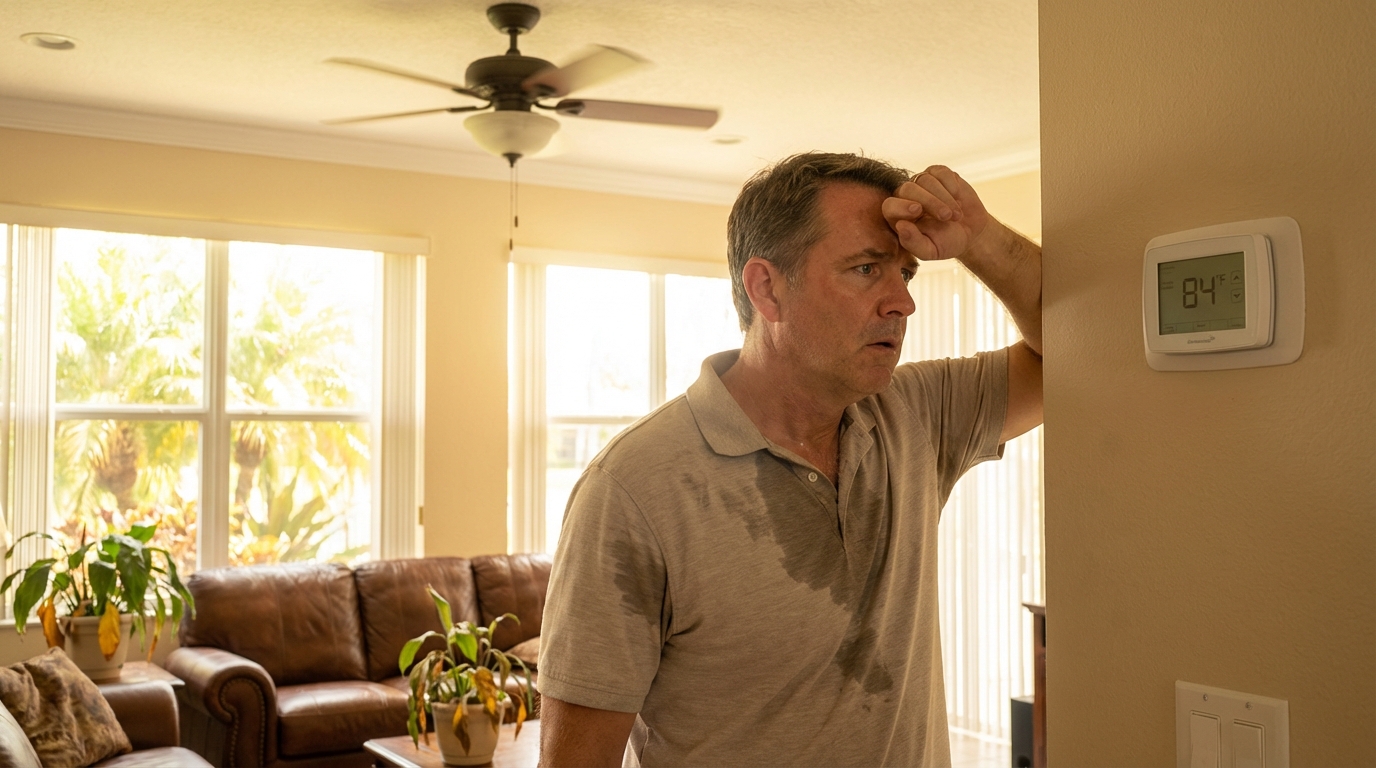
It is 93 degrees outside. You walk into your house expecting relief, and the air coming from your vents feels warm. Your AC is running, but it is not cooling. Before you panic, there are several things you can check yourself that may solve the problem in minutes.
This troubleshooting guide walks Orlando homeowners through the most common reasons an AC stops blowing cold air, what you can fix on your own, and when you need to call a professional AC repair technician. Most of these issues come down to a handful of causes, and understanding them helps you make the right decision quickly.
Need AC repair now?
Same-day diagnostics available across Orlando and 35+ cities.
Check These First (Before You Call Anyone)
Before you pick up the phone, spend five minutes checking these three things. In many cases, one of them is the culprit, and the fix takes seconds.
Thermostat Settings
This sounds simple, but it is one of the most common reasons homeowners think their AC is broken. Check the following:
- Is it set to COOL? Someone in the household may have accidentally switched it to HEAT or OFF.
- Is the fan set to AUTO? If the fan is set to ON, it blows air continuously, even when the compressor is not running. That air will feel warm. Switch it to AUTO so the fan only runs during cooling cycles.
- Is the temperature set low enough? If your thermostat is set to 78 but your house is already at 77, the system will not kick on. Set it 3 to 5 degrees below the current room temperature and wait a few minutes.
- Are the batteries dead? If your thermostat screen is blank or flickering, replace the batteries. Some thermostats lose their programming when batteries die.
Air Filter
A clogged air filter is the single most common cause of AC problems in Florida. When the filter is packed with dust, pet hair, and debris, it chokes off airflow to the evaporator coil. Reduced airflow causes the coil to get too cold, and eventually it freezes over completely.
Pull out your filter and hold it up to the light. If you cannot see light through it, replace it immediately. In Orlando's climate, filters should be replaced every 30 to 60 days. If you have pets, it may need to be even more frequent.
After replacing the filter, give your system 30 minutes to recover before evaluating whether the cooling has improved.
Circuit Breaker
Your AC system uses two breakers: one for the indoor air handler and one for the outdoor condenser unit. If only the indoor fan is running (because its breaker is fine) but the outdoor unit is off (because its breaker tripped), you will feel air from the vents, but it will not be cold.
Check your electrical panel. If a breaker is tripped, flip it all the way off and then back on. If it trips again immediately, do not keep resetting it. That indicates an electrical fault that requires a professional.
Common Causes of AC Not Cooling
If the thermostat, filter, and breaker are all fine, the problem is likely one of the following. These are the issues Trust First Services technicians diagnose most frequently in Orlando homes.
Dirty Air Filter (The #1 Cause)
Even if you checked the filter and it looked "okay," a filter that has been in place for more than 60 days in a Florida home is often dirtier than it appears. The high humidity causes dust and allergens to cling to the filter material and compress into a dense layer that restricts airflow.
A severely restricted filter can cause the evaporator coil to freeze, the blower motor to overheat, and the compressor to strain. Replace the filter, turn the system to FAN ONLY for two hours to let any ice melt, and then switch back to COOL.
Frozen Evaporator Coil
When the evaporator coil freezes, it cannot absorb heat from the air. The result is warm air blowing through your vents. You may also notice water dripping around the indoor unit as ice melts.
Common causes of a frozen coil include:
- Dirty air filter (restricted airflow)
- Low refrigerant (reduced pressure and temperature)
- Dirty coils (reduced heat absorption)
- Blocked return vents (not enough warm air reaching the coil)
- Failing blower motor (weak airflow across the coil)
What to do: Turn off the AC and switch the fan to ON. Let it run for 2 to 3 hours until the ice melts completely. Then check and replace the filter. If the coil freezes again after restarting, you need a professional to check the refrigerant level and coil condition.
Low Refrigerant (Freon)
Your AC does not consume refrigerant like a car consumes gasoline. If the refrigerant level is low, it means there is a leak somewhere in the system. Low refrigerant reduces the system's cooling capacity and eventually causes the evaporator coil to freeze.
Signs of low refrigerant:
- AC runs but does not cool effectively
- Ice buildup on the refrigerant line or coil
- Hissing or bubbling sounds near the indoor unit
- Higher than normal electric bills
Refrigerant leaks require a licensed HVAC technician. It is not a DIY repair. The technician needs to locate the leak, repair it, and recharge the system with the correct type and amount of refrigerant.
Faulty Capacitor
The capacitor provides the electrical boost that starts the compressor and fan motors. When it fails, the outdoor unit may hum but not start, or it may start and quickly shut off. A bad capacitor is one of the most common AC repairs in Orlando and is relatively inexpensive to replace.
Signs of a failing capacitor:
- Outdoor unit hums but the fan does not spin
- AC starts and then shuts off within seconds
- Clicking sound from the outdoor unit
- System struggles to start on hot days
Blocked or Dirty Condenser Unit
The outdoor condenser unit releases the heat that your AC removes from your home. If the condenser coils are caked with dirt, grass clippings, or mulch, it cannot dissipate heat effectively. The system overheats and loses cooling capacity.
Walk outside and inspect your condenser. Is there debris piled against it? Are bushes or landscaping growing within two feet of it? Use a garden hose to gently rinse the coils from the inside out. Make sure the unit has at least two feet of clearance on all sides.
In Orlando, pollen season (February through April) and summer storms deposit significant debris on condenser coils. Monthly cleaning helps prevent this issue.
DIY Fixes vs. Professional Repair
Some AC problems have straightforward fixes you can handle yourself. Others require tools, training, and refrigerant handling certifications that only a licensed technician should attempt.
You Can Fix These Yourself
| Issue | DIY Fix |
|---|---|
| Wrong thermostat settings | Adjust to COOL, fan to AUTO, lower temperature |
| Dirty air filter | Replace with correct size filter |
| Tripped breaker | Reset breaker once (only once) |
| Debris around condenser | Clear 2 feet of space, rinse coils with hose |
| Blocked vents or registers | Move furniture, open closed vents |
| Frozen coil (from dirty filter) | Replace filter, run FAN ONLY for 2-3 hours |
You Need a Professional for These
| Issue | Why It Requires a Pro |
|---|---|
| Low refrigerant | EPA-certified technician required to handle refrigerant |
| Refrigerant leak | Requires leak detection equipment and repair |
| Faulty capacitor | High-voltage electrical component |
| Bad compressor | Major component replacement |
| Electrical fault (breaker keeps tripping) | Fire hazard if misdiagnosed |
| Frozen coil (not caused by dirty filter) | Underlying issue needs diagnosis |
| Strange smells (burning or electrical) | Potential wiring issue or motor failure |
When in doubt, call a professional. An incorrect DIY repair can void your warranty, damage your system, or create a safety hazard.
When to Call an AC Technician
Call a professional AC repair technician if any of the following apply:
- You have replaced the filter, checked the thermostat and breaker, and the problem persists. The issue is beyond basic troubleshooting.
- The breaker keeps tripping. This indicates a short circuit or ground fault that is a fire risk.
- You see ice on the refrigerant line or coil after the filter has been replaced. Low refrigerant or a mechanical problem needs diagnosis.
- The outdoor unit is not turning on at all. Could be a capacitor, contactor, or wiring failure.
- You smell burning or something electrical. Turn off the system immediately and call for service.
- Your AC is cycling on and off rapidly (short-cycling). This stresses the compressor and indicates a control or electrical problem.
- Cooling performance has declined gradually over weeks. Slow decline often points to a refrigerant leak or compressor wear.
Trust First Services provides same-day AC diagnostics in Orlando and 35+ surrounding cities. Our technicians diagnose the problem, explain your options, and provide transparent pricing before starting any work.
AC Repair Costs in Orlando
Knowing what repairs typically cost helps you evaluate quotes and make informed decisions. Here are the average costs for common AC repairs in the Orlando market.
| Repair | Typical Cost Range |
|---|---|
| Diagnostic/service call | $75 - $150 |
| Capacitor replacement | $150 - $300 |
| Contactor replacement | $150 - $350 |
| Refrigerant recharge (with leak repair) | $200 - $600 |
| Evaporator coil cleaning | $100 - $400 |
| Blower motor replacement | $300 - $600 |
| Compressor replacement | $1,200 - $2,500 |
| Circuit board replacement | $200 - $600 |
These are market averages based on Orlando-area pricing. Your actual cost depends on your system's brand, age, and the specific nature of the problem. Trust First Services provides upfront quotes so you know the cost before any work begins.
Is repair worth it? If your system is over 10 years old and the repair costs more than half the price of a new unit, replacement may be the better investment. Read more about the $5,000 rule for HVAC to help you decide.
Frequently Asked Questions
Why is my AC running but not blowing cold air?
The most common reasons are a dirty air filter, frozen evaporator coil, low refrigerant, faulty capacitor, or blocked condenser unit. Start by checking your thermostat settings, replacing the air filter, and inspecting the outdoor unit for debris. If those steps do not resolve the problem, you need a professional diagnosis.
Should I turn off my AC if it is not cooling?
Yes. If your AC is running but not cooling, turn it off to prevent further damage. Running a system with a frozen coil, low refrigerant, or faulty compressor puts additional stress on the components and can turn a minor repair into a major one. Switch the fan to ON (without cooling) to help thaw a frozen coil, and call a technician.
What is the most common reason AC stops cooling?
A dirty air filter is the most common cause. In Florida's humid climate, filters clog faster than in drier states. A clogged filter restricts airflow, causes the evaporator coil to freeze, and forces the system to work harder. Replacing your filter every 30 to 60 days prevents this problem entirely.
How do I know if my AC needs freon?
Signs of low refrigerant include reduced cooling performance, ice on the refrigerant line, hissing sounds near the indoor unit, and higher electric bills. Only a licensed HVAC technician can confirm low refrigerant levels, identify the leak, and recharge the system. Your AC should never need a "top-off." If the refrigerant is low, there is a leak.
Can a dirty filter cause AC not to cool?
Absolutely. A dirty filter is the number one cause of cooling problems. The filter restricts airflow to the evaporator coil, which causes the coil temperature to drop below freezing. Ice forms on the coil, and the system can no longer absorb heat from the air. The fix is simple: replace the filter and run the fan for 2 to 3 hours to thaw the coil.
When should I call a professional?
Call a professional when basic troubleshooting (thermostat, filter, breaker, condenser clearance) does not resolve the problem. Also call immediately if you smell burning, hear unusual sounds, notice the breaker keeps tripping, or see ice that does not melt after replacing the filter. These situations require a trained technician with proper diagnostic equipment.
Schedule AC Repair in Orlando
If your AC is not cooling and you have worked through this troubleshooting guide, it is time to call in a professional. Trust First Services provides fast, honest AC repair across Orlando and 35+ Central Florida cities.
Here is what sets us apart:
- Veteran-owned and minority-owned with 25+ years of home services experience
- Transparent pricing before any work begins
- Same-day service available for most repairs
- All brands serviced, including Carrier, Trane, Lennox, Rheem, and Goodman
- 24/7 emergency availability for urgent cooling failures
Do not spend another night sweating through a broken AC. Trust First Services diagnoses the problem, explains your options clearly, and gets your system cooling again.
Looking for ongoing protection? Ask about our HVAC maintenance plans that include priority scheduling, tune-ups, and repair discounts.