
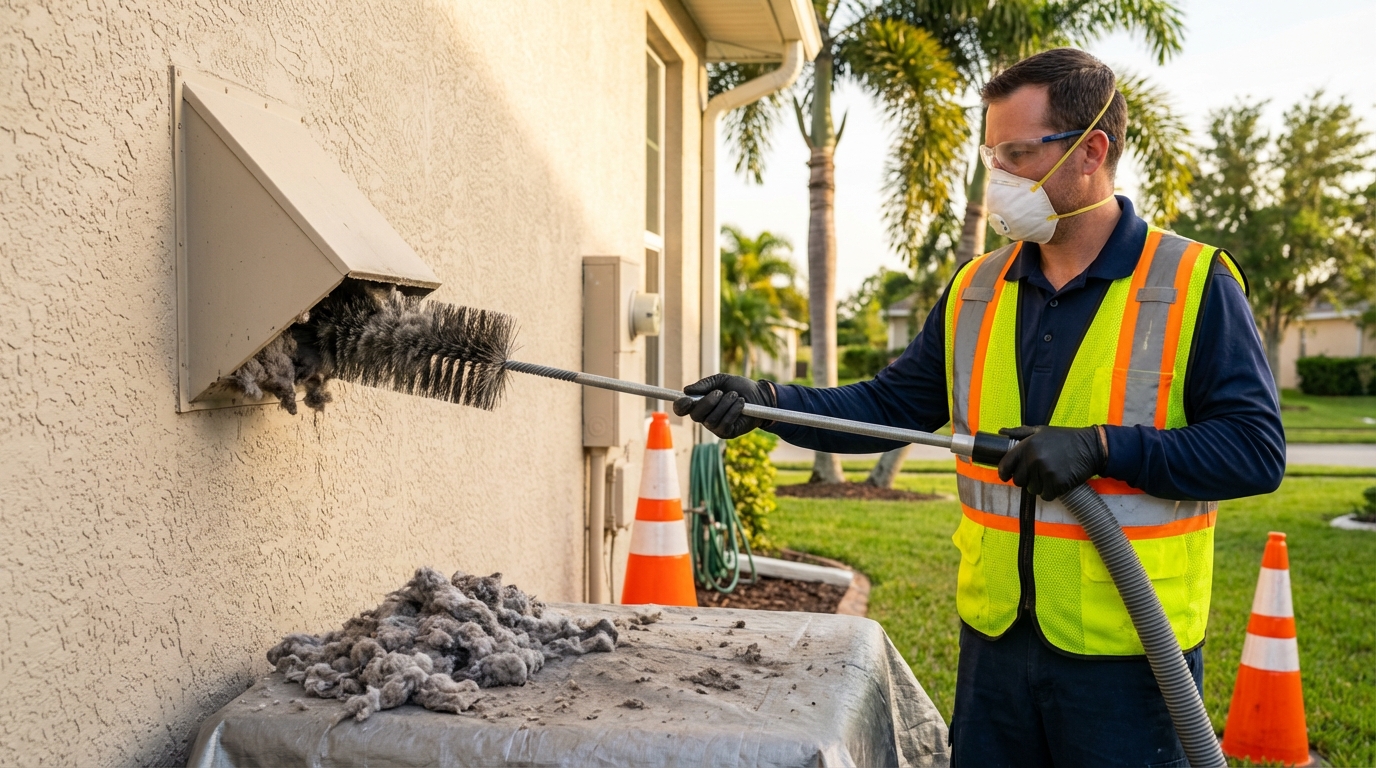
Most homeowners clean the lint trap after every load and assume their dryer is safe. But the lint trap only catches about 75% of the lint your dryer produces. The rest travels into the vent line that runs from the back of your dryer to the outside of your home. Over time, that buildup creates a serious fire hazard, drives up your energy bills, and shortens the life of your dryer.
Dryer duct cleaning removes that hidden lint before it becomes a problem. This guide covers why it matters, how to tell when your vent needs attention, what it costs, and whether you should handle it yourself or call a professional.
Why Dryer Vent Cleaning Matters
A clogged dryer vent is not just an inconvenience. It is a safety hazard that affects your home, your wallet, and your family.
Fire Prevention
The U.S. Fire Administration reports that clothes dryers cause an estimated 2,900 home fires each year in the United States. These fires result in approximately 5 deaths, 100 injuries, and $35 million in property damage annually. The leading cause? Lint buildup in the dryer vent.
Lint is highly flammable. When it accumulates inside your vent line, the restricted airflow forces your dryer to run hotter. That combination of flammable material and elevated heat is exactly what starts a fire. The risk increases with longer vent runs, vents with multiple turns, and vents made from flexible foil or plastic instead of rigid metal.
Regular dryer duct cleaning removes the fuel source and keeps exhaust temperatures where they should be.
Lower Energy Bills
When lint restricts airflow in your dryer vent, your dryer works harder and runs longer to dry each load. A clean vent allows hot, moist air to exit efficiently, which means shorter drying times and less energy consumed per cycle.
According to the U.S. Department of Energy, a clogged dryer vent can increase energy consumption by up to 30%. For a household that does 5 to 7 loads per week, that adds up to noticeable savings over the course of a year.
Extended Dryer Lifespan
Your dryer was not designed to run at maximum effort on every cycle. When a clogged vent forces it to overheat and run longer, the heating element, thermal fuse, blower motor, and drum bearings all wear out faster. Regular vent cleaning reduces strain on these components and helps your dryer last its full expected lifespan of 10 to 13 years.
Faster Drying Times
If your clothes regularly need two cycles to dry, your vent is almost certainly the problem. A clean vent allows air to move freely through the system, which means most loads finish in a single cycle. That saves time, energy, and wear on your clothes.
Signs Your Dryer Vent Needs Cleaning
Your dryer will tell you when the vent is getting clogged if you know what to watch for. Here are the most common warning signs.
- Clothes take longer than one cycle to dry. This is the most common first sign. If a load that used to take 45 minutes now takes 60 to 90 minutes, restricted airflow is likely the cause.
- The dryer feels excessively hot during operation. Touch the top of your dryer during a cycle. If it is uncomfortably hot, the heat is not venting properly and is staying trapped inside the machine.
- A burning smell when the dryer runs. Lint that overheats can produce a hot, burning odor. If you notice this, stop the dryer immediately and have your vent inspected. This is a direct fire warning sign.
- The outside vent flap does not open. Walk outside while your dryer is running and check the exterior vent cover. The flap should be pushed open by the exhaust air. If it stays closed or barely moves, the vent is blocked.
- Visible lint around the dryer connection. Check the area where the vent hose connects to the back of your dryer. If you see lint accumulating around the connection or on the floor behind the dryer, lint is escaping the system and building up inside the vent.
- Your laundry room feels humid or warm. When the vent cannot expel hot, moist air to the outside, that moisture stays in your laundry room. You may notice condensation on windows, a musty smell, or a noticeable temperature increase in the room when the dryer runs.
- It has been more than 12 months since your last cleaning. Even if you do not notice any symptoms, annual cleaning is the recommended minimum. Lint buildup is gradual, and problems often develop before symptoms become obvious.
If you notice two or more of these signs, schedule a dryer vent cleaning before the problem gets worse.
How Often Should You Clean Your Dryer Vent?
The National Fire Protection Association (NFPA) recommends cleaning your dryer vent at least once per year. However, several factors may require more frequent cleaning.
Annual Cleaning (Minimum)
Once per year works for most single-family homes with standard laundry habits (4 to 6 loads per week) and a vent run of 25 feet or less with minimal turns. Annual cleaning prevents the gradual buildup that leads to fire risk and performance issues.
Every 6 Months
You should clean your dryer vent twice per year if any of the following apply:
- You do more than 6 loads per week (large families, households with children, pet owners with frequent bedding washes)
- Your dryer vent run is longer than 25 feet
- Your vent has three or more 90-degree turns
- You have pets that shed (pet hair accelerates lint accumulation)
- You use dryer sheets heavily (residue builds up inside the vent)
Every 3 to 4 Months
Commercial settings, shared laundry facilities, and households that run the dryer daily should consider quarterly cleaning. The higher volume of use means lint accumulates much faster.
Florida-Specific Considerations
In Central Florida, humidity adds an extra factor. Orlando’s average humidity runs above 70% for much of the year, which can cause lint inside the vent to clump and stick to vent walls rather than pass through. Humid lint is harder to remove with each dryer cycle and builds up faster than in drier climates. If your home does not have strong air conditioning in the laundry area, the moisture factor is even more significant.
DIY vs. Professional Dryer Vent Cleaning
Can you clean your dryer vent yourself? In some cases, yes. But there are clear limits to what a DIY approach can accomplish.
What You Can Do Yourself
Basic dryer vent maintenance is within reach for most homeowners:
- Unplug the dryer (or turn off the gas valve for gas dryers) and pull it away from the wall.
- Disconnect the vent hose from the back of the dryer.
- Clean the lint trap housing using a long, narrow brush designed for dryer vents. You can find these at hardware stores for $10 to $20.
- Vacuum the inside of the vent hose and as far into the wall vent as your brush or vacuum attachment can reach.
- Check the exterior vent cover for lint buildup or obstructions (bird nests are common in Florida).
- Reconnect the hose securely and push the dryer back into position.
This basic cleaning is a good supplement between professional cleanings. It can clear the first few feet of the vent line and remove visible lint from the connections.
When You Need a Professional
DIY cleaning has real limitations. A household vacuum and a vent brush can only reach the first 3 to 5 feet of your vent line. The rest of the line, which can run 15 to 40 feet through walls, ceilings, and attic spaces, remains untouched.
Professional dryer vent cleaning is the better choice when:
- Your vent run is longer than 10 feet or has multiple turns
- The vent runs through walls, ceilings, or an attic where you cannot access it
- You notice any of the warning signs listed earlier in this guide
- It has been more than a year since the vent was professionally cleaned
- You have a rigid metal vent installed inside the wall (these require specialized rotary brush equipment)
- You suspect a bird nest, rodent nest, or major blockage in the vent line
Professional technicians use high-powered rotary brush systems and commercial vacuums that reach the entire length of the vent. They can also inspect for damage, improper installation, and crushed vent sections that restrict airflow.
The Bottom Line
DIY maintenance is useful between professional cleanings. But it does not replace a full professional cleaning, especially for longer vent runs or homes where the vent passes through walls or attic spaces. The cost of a professional cleaning is small compared to the cost of a dryer fire or a premature dryer replacement.
Dryer Vent Cleaning Cost
Dryer vent cleaning is one of the most affordable home maintenance services you can schedule. Here is what to expect.
Average Cost
| Service | Typical Cost Range |
|---|---|
| Standard dryer vent cleaning (residential) | $100 – $200 |
| Long vent run (25+ feet) or difficult access | $150 – $300 |
| Vent cleaning with bird nest or major blockage removal | $150 – $250 |
| Dryer vent cleaning bundled with air duct cleaning | Discounted (ask for combined pricing) |
Most residential dryer vent cleanings fall in the $100 to $200 range. The price depends on the length of your vent run, the number of turns, the accessibility of the vent, and the level of buildup.
What Affects the Price
- Vent length and routing: Longer runs with more turns take more time and require more specialized equipment to clean thoroughly.
- Access difficulty: Vents that run through attic spaces, second-floor laundry rooms, or tight crawl spaces may require extra work to access.
- Level of buildup: A vent that has not been cleaned in several years may require additional passes with the rotary brush system.
- Blockage removal: Bird nests, rodent nests, or crushed vent sections add time and complexity to the job.
- Additional services: Many homeowners bundle dryer vent cleaning with air duct cleaning for a combined discount.
Cost vs. Risk
Consider what you are protecting against. A $100 to $200 vent cleaning prevents:
- House fires (average fire damage: $50,000+)
- Higher energy bills (up to 30% more per cycle)
- Premature dryer replacement ($500 to $1,200 for a new dryer)
- Clothing damage from excessive heat exposure
Dryer vent cleaning pays for itself many times over, even if you only factor in the energy savings.
How Trust First Services Cleans Your Dryer Vent
At Trust First Services, dryer vent cleaning is part of our duct cleaning services. Our technicians follow a thorough, consistent process on every job.
Step 1: Inspection
We start by inspecting your dryer vent system from both ends: the connection at the dryer and the exterior exhaust point. We assess the vent material, length, routing, and overall condition. If we identify damage, improper installation, or crushed sections, we let you know before we begin cleaning.
Step 2: Equipment Setup
We connect our professional rotary brush system and high-powered vacuum to your vent line. The vacuum creates negative pressure inside the vent so all dislodged lint is captured rather than pushed further into the system or released into your home.
Step 3: Full-Length Cleaning
The rotary brush travels the entire length of your vent, breaking loose lint, debris, and any compacted buildup from the vent walls. Our equipment reaches every inch of the line, including around turns and through vertical runs that household tools cannot access.
Step 4: Airflow Verification
After cleaning, we verify that air flows freely from the dryer to the exterior exhaust. We check the exterior vent flap operation and confirm that exhaust temperature and airflow are within normal range. You will feel the difference immediately when you run your next dryer load.
Step 5: Recommendations
If we find issues during the cleaning, such as a damaged vent hose, improper vent material, or an installation that does not meet code, we explain the problem and provide recommendations. We also let you know when your next cleaning should be based on your specific vent setup and usage habits.
As a full-service HVAC company, our technicians understand how your dryer vent system interacts with your overall home ventilation. If we identify related issues during the cleaning, such as an HVAC return vent pulling dryer lint back into your air system, we can address it on the same visit.
Frequently Asked Questions About Dryer Vent Cleaning
How often should dryer vents be cleaned?
At minimum, once per year. If you have a large family, pets that shed, a vent run longer than 25 feet, or a vent with multiple turns, cleaning every 6 months is recommended. The NFPA and most dryer manufacturers recommend annual professional cleaning as the baseline.
How much does dryer vent cleaning cost?
Residential dryer vent cleaning typically costs $100 to $200 for a standard vent run. Longer vents, difficult access points, or heavy blockages may cost $150 to $300. Many companies, including Trust First Services, offer discounted pricing when you bundle dryer vent cleaning with air duct cleaning.
Can I clean my dryer vent myself?
You can perform basic maintenance on the first few feet of your vent line using a vent brush and household vacuum. This is a good supplement between professional cleanings. However, DIY methods cannot reach the full length of most vent runs, especially those that pass through walls, ceilings, or attic spaces. For a thorough cleaning that removes all buildup and verifies proper airflow, professional service is recommended.
What are signs your dryer vent needs cleaning?
The most common signs are: clothes taking longer than one cycle to dry, the dryer feeling excessively hot during use, a burning smell when the dryer runs, the exterior vent flap not opening properly, visible lint around the dryer connection, and increased humidity in your laundry room. If you notice any of these, schedule a cleaning promptly.
How many house fires are caused by dryer vents?
According to the U.S. Fire Administration, clothes dryers cause approximately 2,900 home fires per year. Lint buildup in the dryer vent is the leading cause. These fires result in an estimated 5 deaths, 100 injuries, and $35 million in property damage annually. Regular vent cleaning is the most effective prevention.
How long does dryer vent cleaning take?
A standard residential dryer vent cleaning takes approximately 30 to 60 minutes, depending on the length of the vent run, the number of turns, and the amount of buildup. Vents with heavy blockages or those requiring bird nest removal may take slightly longer. The process is not disruptive, and you can resume using your dryer as soon as the cleaning is complete.
Schedule Your Dryer Vent Cleaning
A clean dryer vent protects your home from fire, cuts your energy costs, and extends the life of your dryer. If it has been more than a year since your last cleaning, or if you are noticing longer drying times and excessive heat, it is time to schedule service.
Trust First Services provides professional dryer vent cleaning and air duct cleaning across Orlando and 35 surrounding Central Florida cities. We bring 25+ years of home services experience, veteran-owned accountability, and transparent pricing to every job.
Explore our HVAC services | Learn about HVAC maintenance plans